
As the charging operations industry faces the dual pressures of increasingly competitive service fees and rising operating costs, technological collaboration and system integration are becoming key to breaking through these challenges.
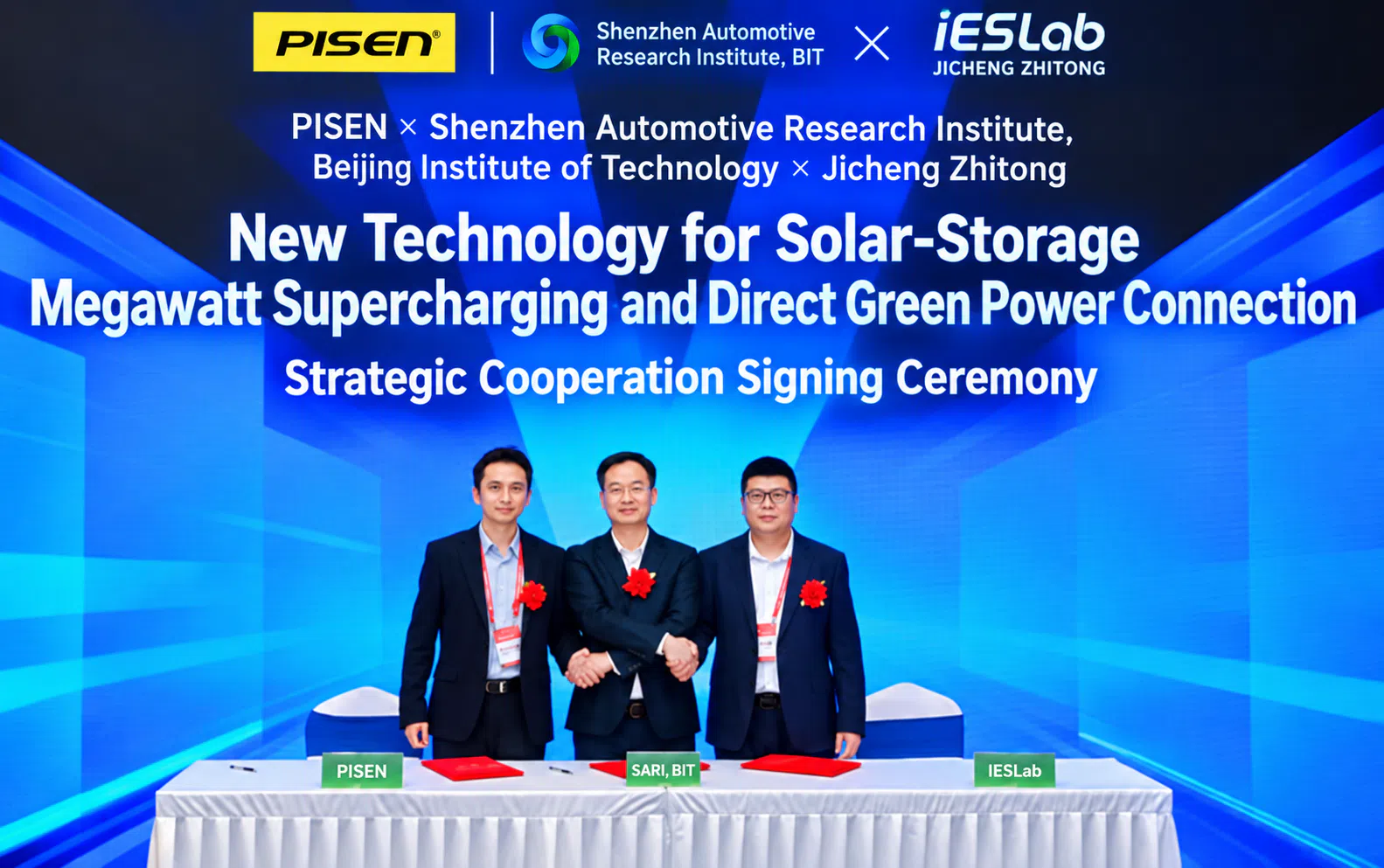
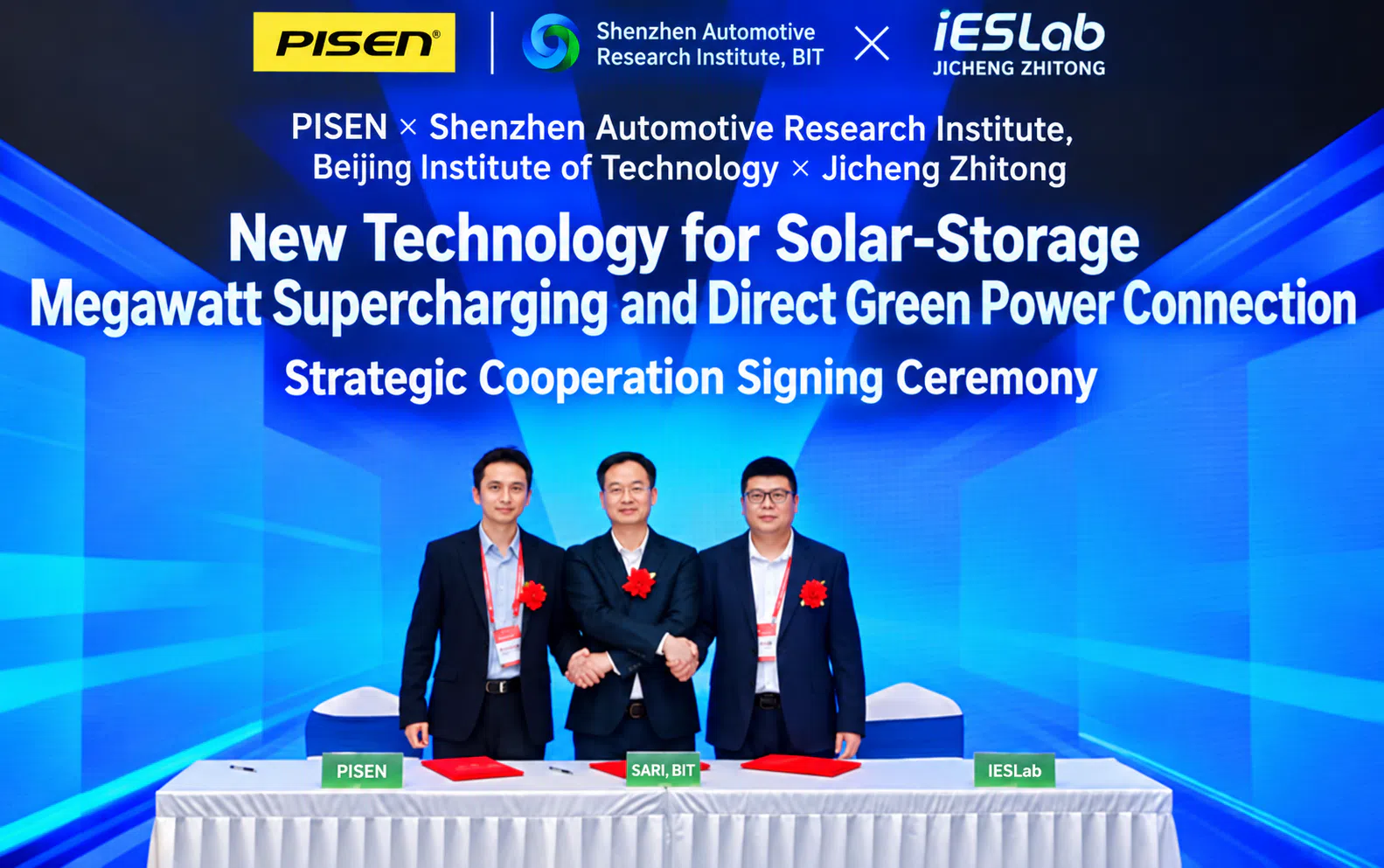
On November 14, during the PISEN Green Power Direct-Connected Megawatt Ultra-Fast Charging & Green Electricity Direct Connection Launch Event at the China Hi-Tech Fair, Jicheng Zhitong, Guangdong PISEN Electronics Co., Ltd., and the BIT Shenzhen Automotive Institute officially signed a tripartite strategic cooperation agreement.
The partnership will further strengthen a collaborative R&D–production–application model and jointly accelerate the deployment of grid-forming solar-storage-charging-discharging integrated systems across multiple application scenarios.
Core Capabilities: Building a Strong Foundation for Technical Collaboration
Under the agreement, Jicheng Zhitong will work with PISEN and BIT Shenzhen Automotive Institute to develop green electricity direct-connection technologies and virtual capacity expansion solutions based on the coordinated requirements of solar generation, energy storage, EV charging, and vehicle-to-grid (V2G) applications.
The solutions are designed to enable precise control and efficient coordination across photovoltaic generation, energy storage charging and discharging, EV charging, and V2G reverse power delivery. This will help ensure safe, stable, and efficient system operation while maximizing renewable energy utilization and project returns.
The collaboration will also address key challenges faced by conventional charging projects, including grid impact and limited revenue streams. By promoting an operating model featuring local energy storage, local consumption, and local settlement, the partners aim to establish a stronger technical foundation for reducing costs and improving project profitability.
Application Scenarios: Creating Benchmarks in Three Key Areas
Leveraging the strengths of all three parties, the cooperation will focus on three core application scenarios:
Upgrading and renovating existing charging stations
Enhancing charging infrastructure at highway service areas
Filling gaps in charging networks along major trunk roads
Jicheng Zhitong’s control systems will be adapted to the operational requirements of different scenarios. For existing charging stations, the solutions can enable cost-effective power expansion. For highway service areas and trunk-road charging networks, they will help ensure stable and efficient charging operations while enabling projects to respond more quickly to market opportunities.
As the partnership develops, the revenue model for charging operations is expected to evolve beyond a single charging service fee toward a diversified structure combining service fees, electricity price arbitrage, and demand-side response.
This shift will help move the industry’s competitive focus from simply increasing charging capacity toward technology-driven cost reduction and operational efficiency.
Looking Ahead: Advancing the Integrated Solar-Storage-Charging-Discharging Market
This strategic partnership represents an important step in Jicheng Zhitong’s expansion into integrated energy services.
Going forward, Jicheng Zhitong will continue to deepen its cooperation with PISEN and BIT Shenzhen Automotive Institute, while further improving the adaptability, intelligence, and overall performance of its control systems to support the implementation of more integrated energy projects.
As competition in the charging operations industry enters a new phase, Jicheng Zhitong will continue to leverage core technologies, work closely with industry partners, and advance the development of integrated solar-storage-charging-discharging solutions, contributing to the high-quality development of the new energy industry.


