
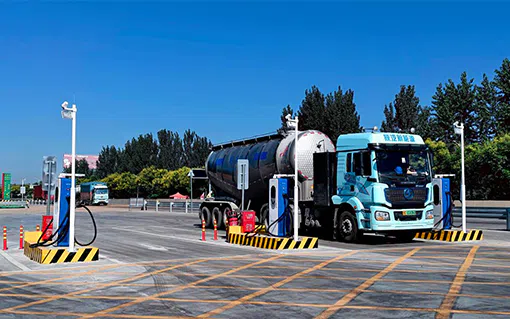
During the summer, a green energy replenishment network for electric heavy-duty trucks is taking shape at an accelerated pace across Shandong’s highways and national and provincial trunk roads.
In April 2026, Shandong Province issued the Implementation Plan for the Development of High-Power Charging Demonstration Stations for Electric Heavy-Duty Trucks Along Key Highway Freight Transport Corridors in Shandong Province (2026–2027), officially launching the construction of high-power charging demonstration stations for electric heavy-duty trucks. With high-power charging as a key driver, a new phase of low-carbon transformation in road freight transportation is now underway across the province.
Policy-Led Development: Building a Green Freight Network Across Shandong
Under the implementation plan, Shandong will focus on developing two major green charging networks.
The first is the “Four Vertical and Two Horizontal” highway corridor network, centered around major highways including the Beijing–Shanghai, Beijing–Taipei, Shenyang–Haikou, Qingdao–Yinchuan, Changchun–Shenzhen and Rizhao–Lanzhou expressways. The network connects all 16 cities in Shandong, covering more than 2,300 kilometers. During 2026–2027, the province plans to build 48 demonstration stations at 24 pairs of highway service areas.
The second is the “Four Vertical and Three Horizontal” national and provincial trunk-road network, covering 14 major freight corridors with a total length of more than 6,600 kilometers and featuring 107 demonstration charging stations.
From planning to actual operation, Shandong is following a government-guided, market-driven approach. The province is also coordinating the development of integrated PV-storage-charging infrastructure while introducing supporting measures covering road access incentives, financing and taxation, and land-use guarantees. Together, these initiatives are helping build a comprehensive ecosystem for the wider adoption of electric heavy-duty trucks.
Two Networks Advancing Together: Connecting Shandong’s Green Charging Corridors
Driven by these policies, construction of demonstration stations is rapidly moving from planning to operation.
On August 31, 10 high-power charging demonstration stations at five pairs of highway service areas began operation. This brings the total number of operational highway demonstration stations in Shandong to 20 stations at 10 pairs of service areas, covering seven cities including Jinan, Qingdao, Weifang, Jining, Rizhao, Linyi and Binzhou. Shandong’s green charging “ring corridor” for electric heavy-duty trucks has now officially taken shape.
At the same time, a number of high-power charging demonstration stations along national and provincial trunk roads have also entered operation across the province.
With highway and trunk-road networks advancing in parallel, the construction of Shandong’s “Four Vertical and Two Horizontal” highway corridors and “Four Vertical and Three Horizontal” national and provincial trunk-road corridors has entered a period of accelerated deployment.
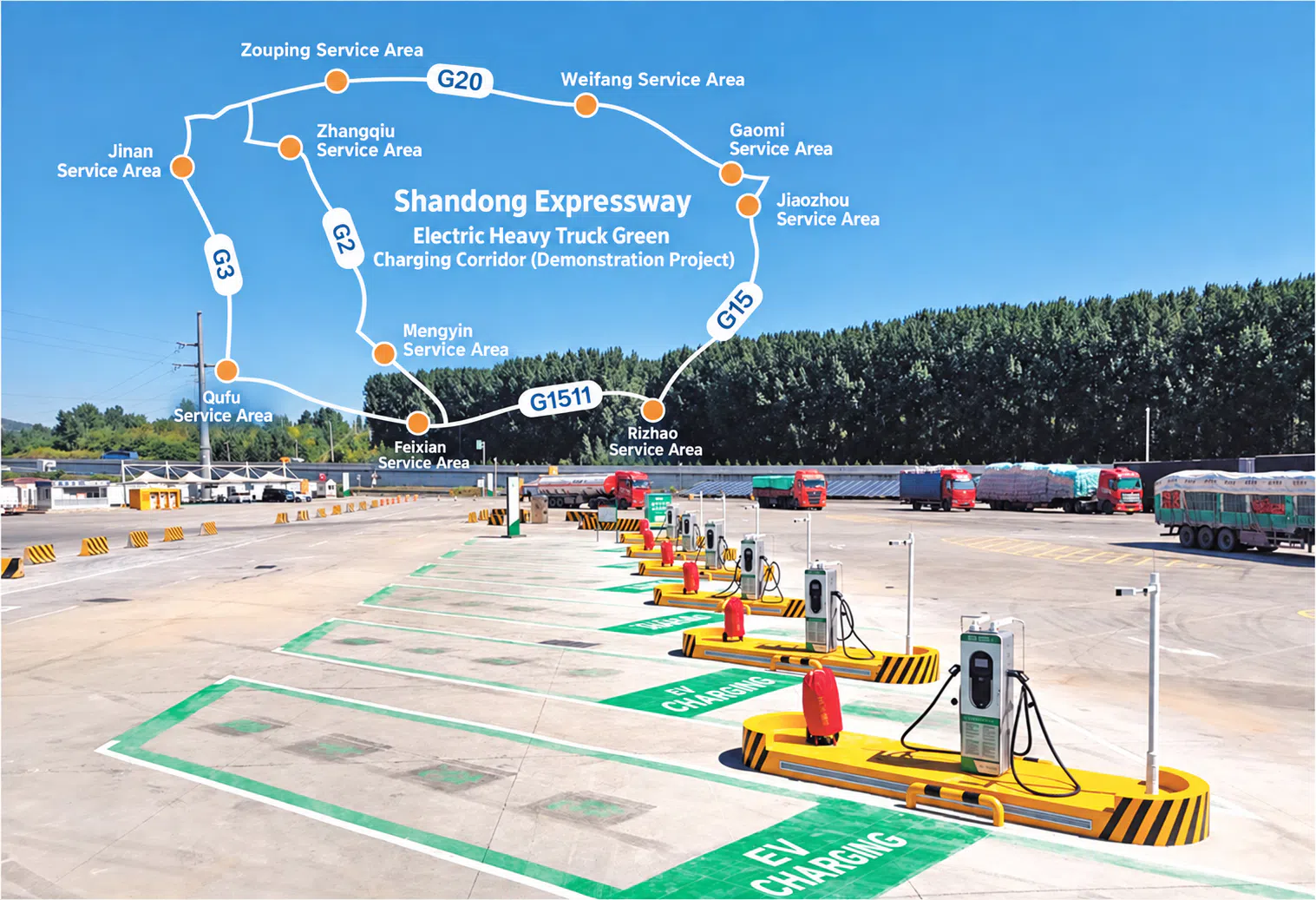
As a leading provider of integrated new energy solutions in China, Jicheng Zhitong has closely followed the development of Shandong’s demonstration charging network and has participated in the construction of more than 20 high-power charging demonstration station projects for electric heavy-duty trucks.
These projects cover multiple cities, including Jinan, Weifang, Heze, Linyi, Zaozhuang and Jining, with applications spanning highway service areas, freight hubs along national and provincial trunk roads, and strategic charging stations near industrial parks.
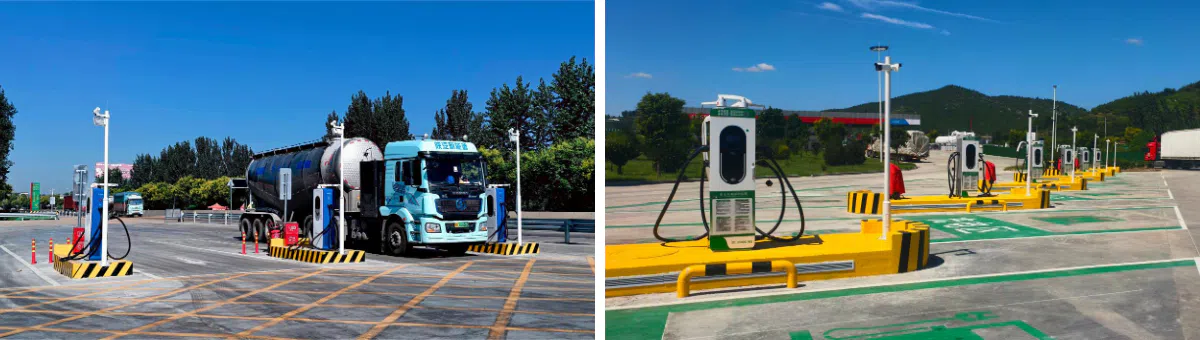
Whether serving key nodes along highway corridors or high-density freight routes on national and provincial roads, Jicheng Zhitong’s charging equipment and engineering services have been integrated into critical points across Shandong’s charging network.
From equipment supply to on-site commissioning, Jicheng Zhitong has been deeply involved throughout the project lifecycle, providing the hardware foundation needed to deliver megawatt-level charging capabilities at demonstration stations.
Advanced Technology: Tackling the Real-World Challenges of Heavy-Duty Truck Megawatt Charging
At the core of these projects is Jicheng Zhitong’s flagship Intelligent Flexible Interconnected Group-Control Charging System, which has been deployed at multiple demonstration stations.
The system is designed to address several key challenges associated with high-power charging infrastructure for electric heavy-duty trucks, including large instantaneous power demand, limited grid expansion capacity, and mixed charging requirements across different vehicle models.
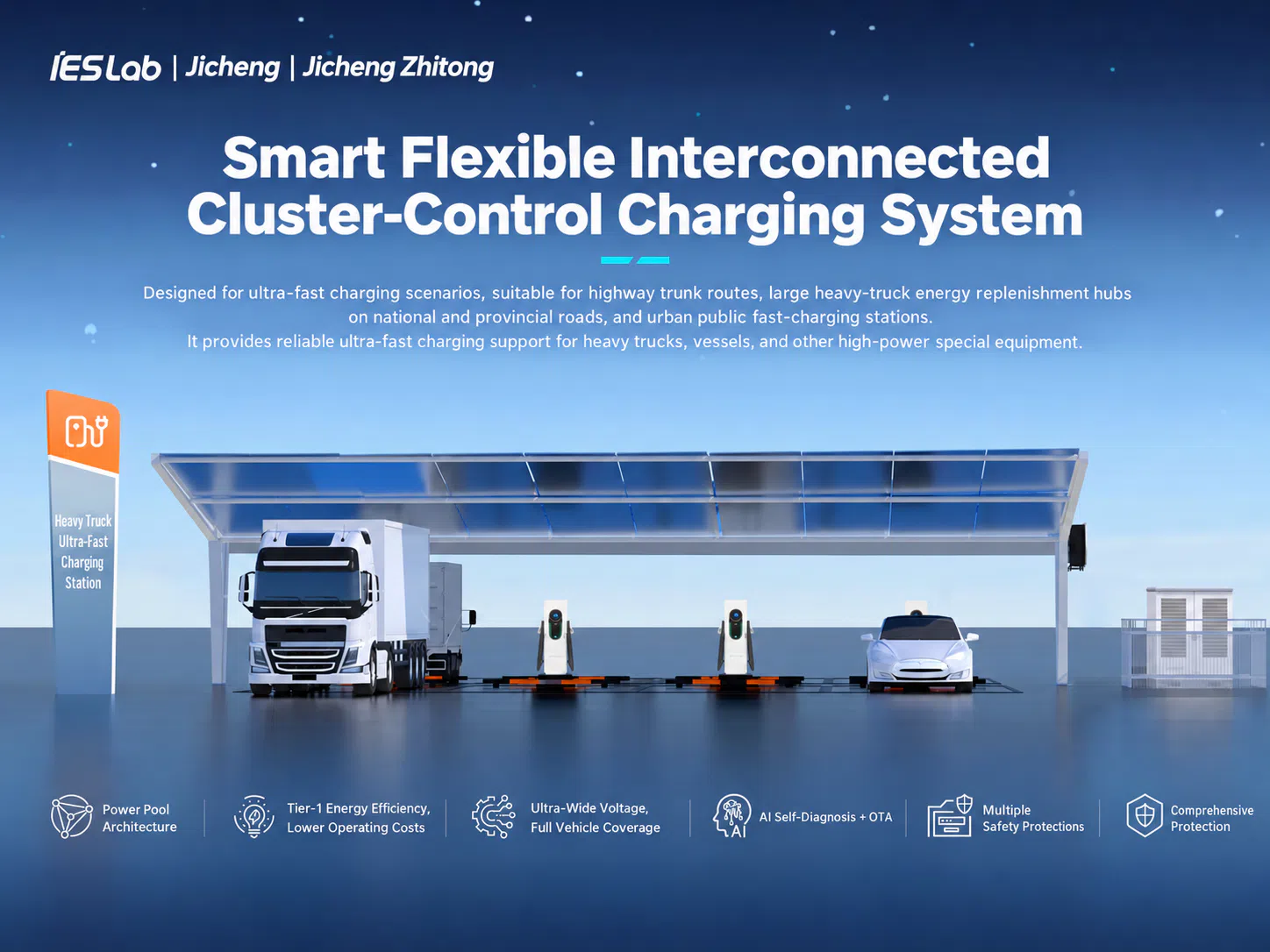
Built around a modular power-pool architecture, the system can be expanded to more than 4.8 MW. Its dynamic power management technology intelligently distributes charging power according to real-time demand, enabling fast charging for heavy-duty trucks with different battery states while also supporting other commercial and passenger vehicles.
The system incorporates 108 active protection mechanisms and works closely with the vehicle’s BMS (Battery Management System) to continuously monitor battery conditions and identify potential risks in advance. This shifts charging safety from post-event response toward proactive risk prevention.
With AI-based self-diagnostics and OTA remote upgrade capabilities, the system can provide early fault warnings and support intelligent fault handling, helping reduce the operational and maintenance burden of charging stations.
In addition, the system can work in coordination with PV generation and energy storage facilities, supporting Shandong’s integrated PV-storage-charging development strategy. By enabling local consumption of renewable electricity and reducing the impact of high-power charging on the distribution grid, it helps facilitate coordinated operation across the source-grid-load-storage system.
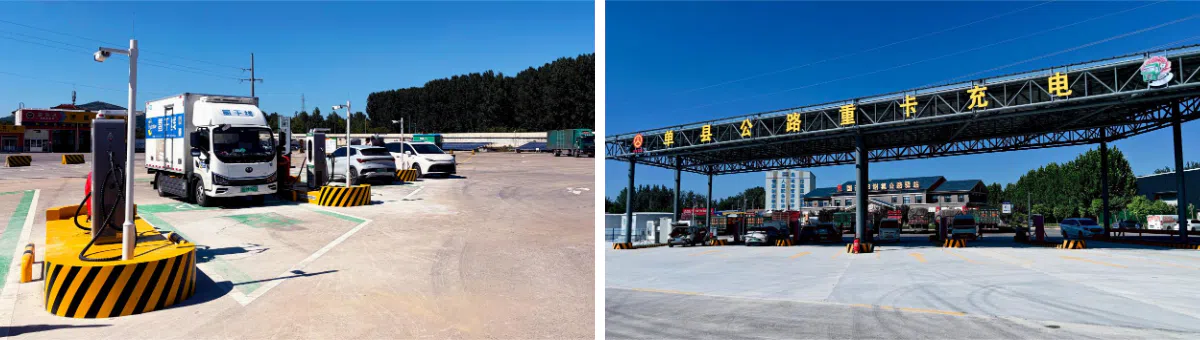
Up to 800 kW per Charging Gun: Enabling Faster Heavy-Truck Turnaround
Currently, charging bays at demonstration stations are configured according to a “one charger, two guns” standard, with up to 800 kW per charging gun. A single charging bay can therefore support megawatt-level charging.
According to current estimates, mainstream electric heavy-duty trucks can complete charging in approximately 15–20 minutes under suitable conditions, significantly improving charging efficiency and helping reduce turnaround time for long-haul freight operations.
As supporting PV and energy storage facilities and intelligent energy management systems are further deployed, these stations will also enable services such as local renewable-energy consumption and scheduled charging, further improving the overall charging experience.
Coordinated Charging Networks: A New Model for Low-Carbon Freight in Shandong
The large-scale deployment of high-power charging demonstration stations for electric heavy-duty trucks, together with the integrated development of highway and national/provincial trunk-road charging corridors, is establishing Shandong as a benchmark for the green transformation of road transportation.
More importantly, the emerging charging network provides a replicable and scalable “Shandong model” for the low-carbon development of road freight and the large-scale deployment of high-power charging infrastructure for electric heavy-duty trucks across China.
Looking ahead, Jicheng Zhitong will continue to focus on the new energy transportation sector, leveraging advanced technology as the driving force, reliable products as the foundation, integrated solutions as the pathway, and full-process service capabilities as the support.
By helping reduce costs and improve efficiency across long-haul freight transportation, Jicheng Zhitong is committed to accelerating the practical implementation of China’s “Dual Carbon” goals, supporting the development of a stronger transportation sector, and contributing continued technological momentum to the green and high-quality development of transportation nationwide.


